Quick answer
Commercial AC wallboxes and DC dispensers typically send an ISO/IEC 14443 A/B card token (`idTag`) from the Linux charge controller to an OCPP backend. Choose PR-203 when your controller uses standard `pcsclite`, PR-106 for native C/C++ `uFCoder` SDK control, or PR-403 for open-source `libNFC` stacks—and qualify RF range behind your UV-stabilized polycarbonate front cover alongside high-current switching contactors.
The worked examples explain software handling. They are not reader measurements or proof of card authentication. Sources and scope · Read our editorial method
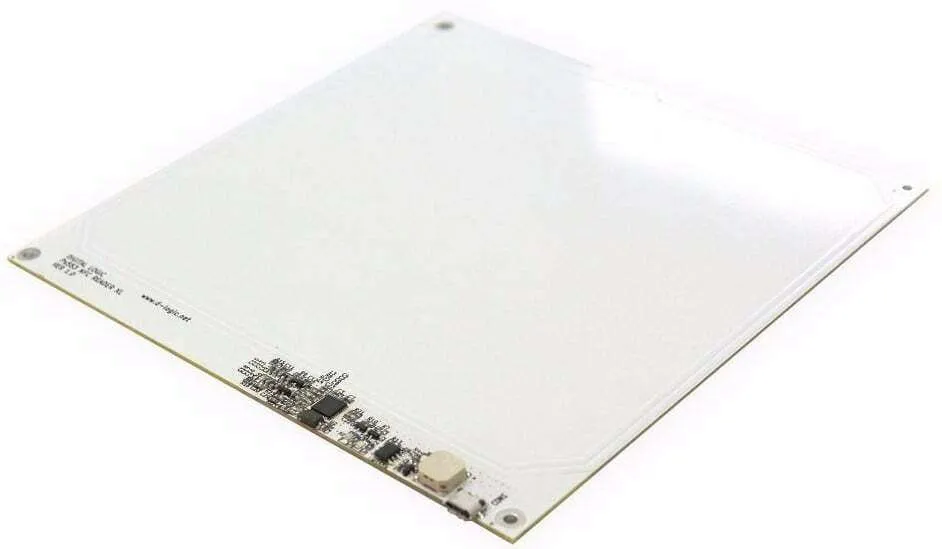
All three XL OEM modules share a bare-board footprint for behind-fascia mounting while serving distinct Linux or embedded software stacks.
Match the bare-board XL module to your EVSE charge controller
| Catalogue model | Catalogued host link | Controller software stack | EVSE integration fit |
|---|---|---|---|
| PR-203 | USB OEM Standard | PC/SC (pcsclite / WinSCard) |
Linux OCPP controllers using standard smart-card services |
| PR-106 | USB OEM configuration | Manufacturer uFCoder C/C++ SDK |
Embedded Linux / MCU bridges needing direct frame control |
| PR-403 | USB OEM module | Open-source libNFC / libusb |
Custom Yocto / Buildroot Linux stacks built on libnfc |
Four EVSE-specific RF, EMI and environmental validation steps
- Test card read distance through the final UV-stabilized polycarbonate window (typically 2–4 mm) keeping aluminum heat sinks and metallic inks outside the coil keep-out zone.
- Run continuous card-polling endurance tests while AC contactors or DC power stages switch load to verify USB cable shielding and 5 V rail filtering.
- Clarify interface variants early: catalogued PR-203, PR-106 and PR-403 listings specify USB OEM modules; request an explicit variant check if your EVSE board requires
TTL UARTorRS-232. - Confirm thermal operating margin, conformal coating needs and end-product EMC/radio compliance inside your sealed outdoor charger housing.
Check OEM specifications and request EVSE pilot modules
Review our OEM NFC integration brief, browse OEM NFC modules and inspect PR-203 PC/SC OEM, then request an EVSE OEM sample evaluation.
Official references and scope
Bare OEM modules do not confer end-product outdoor IP ingress, IK impact or EVSE regulatory approvals on their own; qualify the complete charger assembly in an accredited lab.
Questions to consider
Can an EV charger pass OCPP `idTag` strings using plain UID reads, or should it use mutual authentication?
Many public networks still map 4-byte or 7-byte UIDs to OCPP `idTag`, while closed corporate fleets increasingly authenticate protected application files on ISO/IEC 14443-4 cards to prevent cloning; all three XL modules support full APDU/frame exchange.
Are PR-203, PR-106 and PR-403 weatherproof on their own?
No. They are unhoused internal OEM PCB modules designed to mount inside your weather-sealed EVSE enclosure behind a non-metallic window.